The systems behind websites that scale past $1M
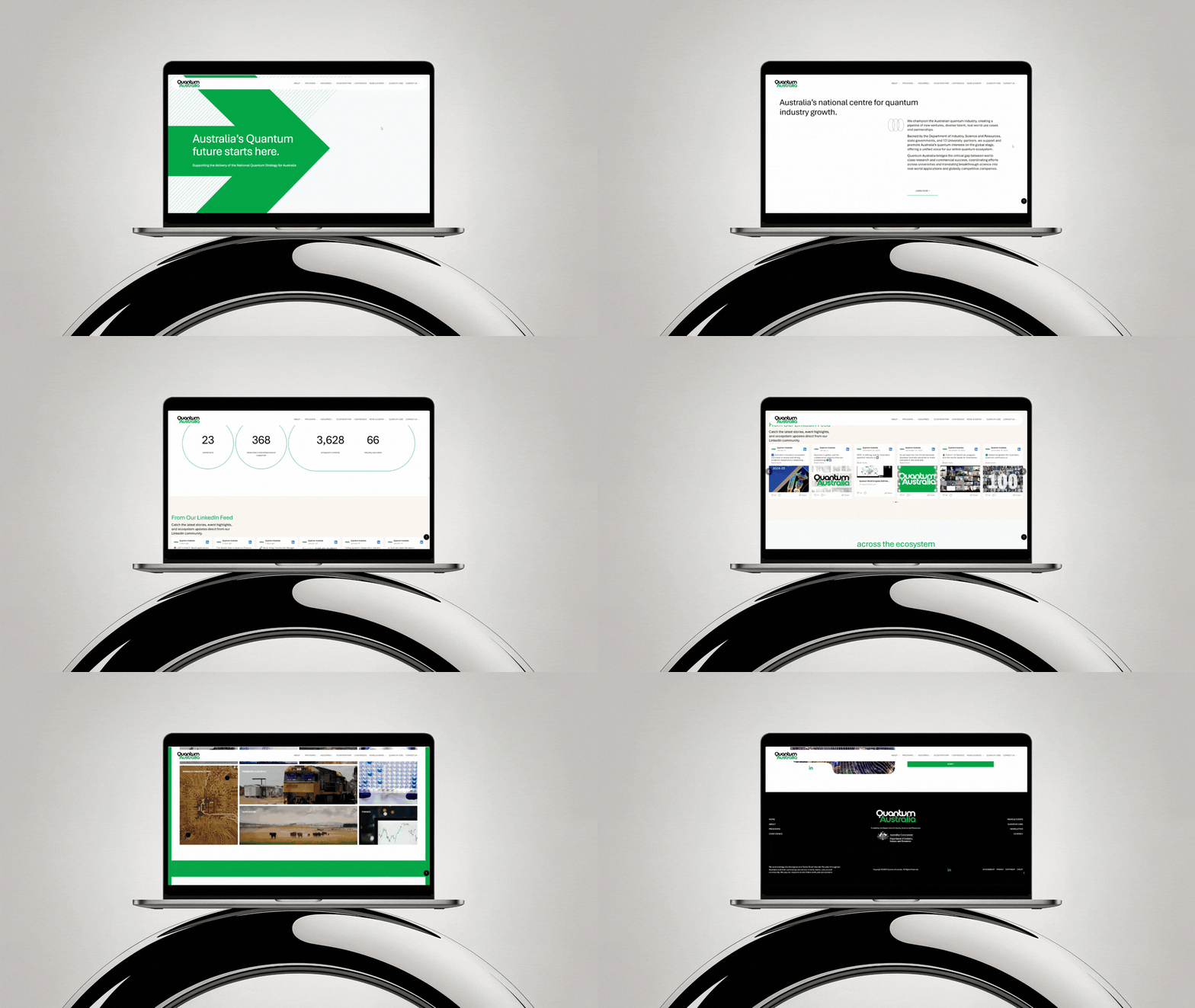
High-growth businesses often pour money into visually striking websites - cinematic hero sections, subtle motion, and premium photography. However, the common misconception is that it's not aesthetics that determine whether a company scales past $1M, but rather the infrastructure behind it.
If your goal is to reach this revenue level, your website must stop behaving like a marketing brochure and start functioning as mission-critical operations software. Good design is relatively easy to achieve. Scaling your business without constant chaos is not.
The highest-leverage websites are quiet, predictable and boring in the best possible way - they absorb complexity, eliminate unnecessary decisions and tasks and let the leadership team focus on expansion instead of daily triage.
Why “pretty design” isn’t enough (and often becomes expensive)
Most websites are launched as artifacts - finished artworks to be admired, where the “success” of the digital presence is determined by what’s on the surface level: motion design, visual hierarchy, mobile polish. Those elements matter for first impressions but they are short-lived advantages. For businesses generating meaningful revenue, the real value lies in what happens after the visitor arrives:
Can a non-technical team member safely update pricing, product details or availability without calling a developer?
Is the lead-to-customer journey repeatable and mostly automated, or does every new deal require manual stitching?
Does the site actually talk to your CRM, payment processor, inventory system and support tools - or are you still living in Zapier duct-tape heaven?
Websites without any systems slowly become obsolete as the company evolves. Teams start working around the site instead of through it.
A beautiful website without these systems is a liability dressed up as an asset. It projects capability while quietly leaking time, margin and trust. Templates and page-builders that feel “good enough” at lower revenue levels start costing serious money at scale: small changes break layouts, integrations drift out of sync, onboarding friction compounds and teams invent workarounds (Google Docs, PDFs, separate booking calendars) that fragment the customer experience and internal operations.
The longer you delay building proper systems, the more expensive the eventual rebuild becomes - both in dollars and in lost momentum.
The four pillars of a website built for scale
A website that can carry a $1M+ business rests on four pillars. Ignore any of these and growth becomes unnecessarily painful.
1. Operational clarity
Every major process the business runs - lead capture → qualification → proposal → onboarding → delivery → support - must have a deliberate, documented flow that the website either executes or strongly supports.
This requires a clean separation between:
Content (copy, images, offers)
Structure (information architecture, navigation logic)
Presentation (CSS, animations)
When these layers are entangled, updates become risky and slow. When they’re cleanly decoupled, the site stays calm even when the business is chaotic. Predictability under pressure is the goal.
2. Scalable infrastructure
We start any build with the end in mind - not finishing the project but if and how the build breaks down.
Always assume failure is coming: APIs will change, traffic will spike, platforms will deprecate features, team members who know how to update things will leave. A serious infrastructure is built to survive those events with minimal drama.
Key traits:
A modular website platform, CRM or tool that allows content updates without touching code
Clean, well-documented integrations (CRM, payments, email automation, calendars, support tools)
Minimal third-party dependencies with clear fallback paths
Cloud hosting that auto-scales (not shared hosting surprises or open-source hackable platforms)
Versioned documentation that is accessible by all team members, not private notes in someone’s Notion
Infrastructure done right feels invisible - until you see competitors go down during Black Friday-level traffic while your site keeps humming.
3. Decision-focused User Experience
Forget “delight” and experimental flourishes.
At scale, UX exists to move people confidently to the next logical action in the customer workflow while aligning perfectly with the necessary backend operations to make that happen.
Every important page should answer two questions:
What primary decision is the visitor trying to make right now?
What needs to happen immediately after they make it?
When those two answers are in sync, conversion improves organically - no aggressive pop-ups or countdown timers required. Misalignment (beautiful form → data vanishes into the ether) destroys trust and revenue.
4. Founder & team autonomy
The ultimate test: how much of the business keeps running if the founder is offline for two weeks?
A mature website behaves like a quiet, reliable team member. Non-technical staff can:
Update content and offers
Manage availability calendars
Process orders
Trigger automated workflows
Pull basic analytics reports
Role-based permissions, intuitive admin interfaces, audit trails and automated guardrails make this possible. When autonomy is high, the founder can step out of operations and into strategy without the business stalling.

Start with process mapping, not design
When re-designing a website, the instinct is to open Figma and start playing with visuals. For any business serious about seven figures, that sequence is backwards.
Step 1: Map the critical processes that must happen reliably at 2×, 5× and 10× current volume.
Lead intake → qualification → proposal → contract → onboarding
Payment & invoicing flows
Post-sale communication & support triggers
Content updates that happen weekly/monthly
Step 2: Identify every point of friction, data hand-off or manual intervention.
Step 3: Design the website to remove or automate as many of those as possible.
Only after evaluating these first then do visuals enter the conversation - and they should serve the workflow, never complicate it.
The quiet truth about high-performance websites
Internally, a website built for real scale feels almost boring: stable, predictable, forgiving, low-maintenance. That boredom is not a lack of ambition; it is evidence that the systems are working.
The internet is noisy. Most websites add to the noise. The ones that endure do the opposite: they reduce cognitive load, make the correct path obvious and quietly compound momentum. If your current website requires frequent heroic effort just to keep the business running, it is not supporting growth - it is taxing it.
Stop optimising for applause.
Start building infrastructure that:
Protects margin
Reduces decision fatigue
Scales without proportional headcount
Works while you sleep
That is how small to medium-sized businesses become large ones without burning out or breaking. The technology exists. The question is whether you’re willing to treat your website as the strategic asset it needs to become.
Want to know how your website stacks up against your competitors and in your industry? Get a website audit with Gem Media to find out.